Learn More

The First Rule of Spray Foam Application

Since spray foam insulation is manufactured and installed on site, the product you receive will only be as good as the installer applying it. It is very important that your installer is not only certified and trained but has logged over 2000 hours in a developed apprenticeship program. All of our applicators have gone through an apprenticeship program developed by Ener-Spray System Inc. "The University of Ener-Spray" that starts our field staff as helpers to a certified sprayer. They are trained and educated about the spray foam process and are advanced through a three stage program as they meet skill set requirements and log over 2000 hours of practical field experience.

The Highest Standard in Quality Control

We are committed to providing the highest levels of quality and service, and believe that dedication to these principals will not only benefit our clients, but better the industry as a whole. Aside from having the best spray foam insulation applicators in the industry, we also have a traceable quality control program. Every job is inspected for quality of foam and workmanship and is then logged and archived as part of our lifetime warranty program.

Safety First, Safety First, Safety First!

All employees at Ener-Spray adhere to a strict safety protocol program and are WHIMIS trained. Site supervisors are trained in first aid and continually reinforce the importance of a safe work environment. Our trucks are equipped with first aid kits, eye wash stations, fire extinguishers and all applicable MSDS reports.

learn_more


Click on the product you would like to learn more about:

half-pnd-downtwo-pnd-downfibre-attic-downpoly-up
airkrete-upttr-down

1/2 lb. Spray Foam

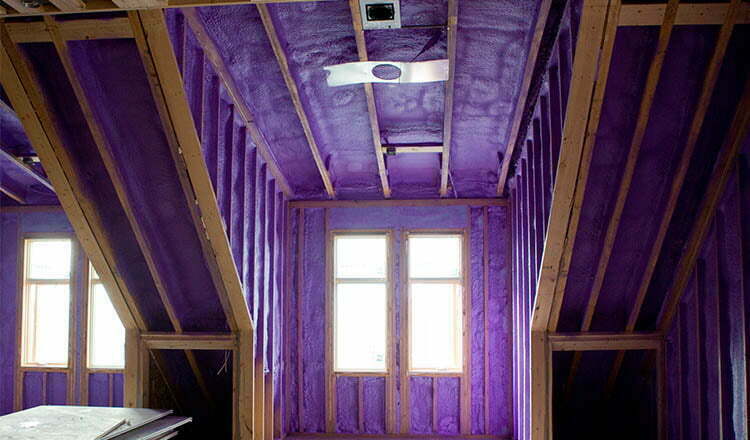
½ lb. foam is spray-applied as a liquid and expands within seconds to 120 times its liquid volume. The foam adheres directly to the substrate forming a seamless and permanent coverage over and around even the most difficult shapes. This seal provides superior energy efficiency and improved indoor air quality by eliminating air movement through walls. Once in place, ½ lb. foam maintains its performance for the life of the building. Unlike many conventional insulations time and temperature changes have no effect on R-value of spray foam insulation. ½ lb. foam is non toxic spray foam which has undergone extensive testing and meets building code requirements.

It is a green product developed with the environment in mind. Its unique formula contains no ozone-depleting chemicals, such as CFCs, HCFCs, fibres, formaldehyde and asbestos. No toxins are emitted during preparation and installation, and since it never decomposes or deteriorates there are no concerns about harmful fibres or gases escaping into the air in the future. ½ lb. foam reduces airborne noise and dust making it the healthy choice for those who suffer from allergies, asthma or chemical sensitivity.

Cold Floors Over Garages and Places Where the House Hangs Past the Foundation

Many houses have rooms built out over the garage or floor spaces that cantilever past the foundation. These rooms tend to be very cold in the winter due to poor insulation, improper air-barrier and vapour seal. As a result of these problems these floor spaces can also be susceptible to moisture and mold. It is common practice for Ener-Spray to remove the old inefficient insulation in these spaces, dispose of it and replace it with ultra efficient Ener-Spray foam insulation. This provides a complete air seal, a higher R-value and a continuous vapour barrier. The Ener-Spray system has been proven for over 10 years to perform in these areas and has become the industry standard for quality home builders. Click our contact link to request a free insulation evaluation.

Cold Flat Roof Systems or Low Pitched Roofs on Older Homes

Many older homes built in the 1960’s to 1980’s have low sloped vault or flat roof systems with insufficient insulation which results in significant heat loss, high energy bills and a cold uncomfortable environment. In these situations Ener-Spray can replace your old inmisulation with high efficient spray foam bringing your R-value up to modern code eliminating moisture problems and heat loss. This application is best to be done when a home owner is replacing the shingles on their roof and we can spray down onto drywall or wood tongue in groove creating a perfect seal and a new uncompromised vapour barrier. This system is proven and has received rave reviews from our customers. Click on our contact link to request a free insulation evaluation.

Basement Walls

Many basements are cold due to the fact that most of the heat in basements is drawn out through the cement walls into the ground creating a continuous heat sink that draws heat out of your home. These cool temperatures transfer to your upper floors causing your home to heat itself more often costing you money in high energy bills. With only 2 inches of Ener-Spray foam you can eliminate 95% of thermal transfer into your basement walls creating a warmer environment, a complete vapour barrier and savings in energy costs. Click on our contact link to request a free insulation evaluation.

Back to top

2 lb. Spray Foam

Read what Mike Holmes has to say about 2 Lb. Spray Foam. Click Here

2 lb. Ener-Spray foam acts as a vapour barrier, insulation and air barrier all in one. 2 lb. foam has a similar application process to that of ½ lb. foam it adheres directly to the substrate forming a seamless and permanent coverage over and around even the most difficult shapes. However, it only expands to 40 times its liquid volume it seals cracks and joints, and around protrusions such as brick ties it forms a continuous insulating air barrier that remains for the life of the building. With one of the highest R-values per inch of any insulating material available, 2 lb. Ener-Spray foam helps reduce energy costs while improving building comfort as well as indoor air quality and comfort. Dust and other exterior pollutants cannot enter the building because of the continuous air tight seal.

2 lb. foam is also a green product with a unique formula that contains no ozone-depleting chemicals, such as CFCs, HCFCs, or fibres, formaldehyde and asbestos. No toxins are emitted during preparation and installation and since it never decomposes or deteriorates, there are no concerns about harmful fibres or gases escaping into the air in the future. 2 lb. Ener-Spray foam also adds structural strength, and increases shear and racking strength by 300% to a building.

Cold Floors Over Garages and Places Where the House Hangs Past the Foundation

Many houses have rooms built out over the garage or floor spaces that cantilever past the foundation. These rooms tend to be very cold in the winter due to poor insulation, improper air-barrier and vapour seal. As a result of these problems these floor spaces can also be susceptible to moisture and mold. It is common practice for Ener-Spray to remove the old inefficient insulation in these spaces, dispose of it and replace it with ultra efficient Ener-Spray foam insulation. This provides a complete air seal, a higher R-value and a continuous vapour barrier. The Ener-Spray system has been proven for over 10 years to perform in these areas and has become the industry standard for quality home builders. Click our contact link to request a free insulation evaluation.


Cold Flat Roof Systems or Low Pitched Roofs on Older Homes

Many older homes built in the 1960’s to 1980’s have low sloped vault or flat roof systems with insufficient insulation which results in significant heat loss, high energy bills and a cold uncomfortable environment. In these situations Ener-Spray can replace your old insulation with high efficient spray foam bringing your R-value up to modern code eliminating moisture problems and heat loss. This application is best to be done when a home owner is replacing the shingles on their roof and we can spray down onto drywall or wood tongue in groove creating a perfect seal and a new uncompromised vapour barrier. This system is proven and has received rave reviews from our customers. Click on our contact link to request a free insulation evaluation.

Basement Rim Joist Ends

Most penetrations into your home and the source of most of your homes air leakage comes through your joist cavities under your floor. This space is where the majority of your utilities come into your home and your house sits on an uneven cement foundation wall providing spaces for cold air to enter into your home. Ener-Spray foam seals these areas completely providing a perfect seal, a new vapour barrier and the highest R-value. This system stops the majority of drafts into basements and energy loss between floors. Click on our contact link to request a free insulation evaluation.

Basement Walls

Many basements are cold due to the fact that most of the heat in basements is drawn out through the cement walls into the ground creating a continuous heat sink that draws heat out of your home. These cool temperatures transfer to your upper floors causing your home to heat itself more often costing you money in high energy bills. With only 2 inches of Ener-Spray foam you can eliminate 95% of thermal transfer into your basement walls creating a warmer environment, a complete vapour barrier and savings in energy costs. Click on our contact link to request a free insulation evaluation.

Back to top

Polyurethane Foam Slab Lifting and Void Fill

The Difference

What is the difference between Mudjacking and Polyurethane Concrete Raising?
Both methods achieve the same results: Raise and Support sunken or unstable concrete slabs by drilling holes and pumping material under the slab.

Material

Settled concrete is commonly a result of poor soil conditions below a slab. As a result Polyurethane has become a popular repair methods because the material is so lightweight it will not further burden the already weak soil. Mudjacking uses a sand based material that is infused with portland cement. This slurry is hydraulically pumped under the slab to fill voids and raise the concrete. Mudjacking material weighs on average 100 lbs per cubic foot. Polyurethane Concrete Raising uses a foam material that is injected under the slab. When the components of this material are mixed a reaction causes the material to expand. This expanded foam fills any voids and raises concrete. This material will never lose density. After it is installed it is permanent and weighs about 2 lbs per cubic foot.

Holes

After concrete has been raise the only visable evidence that the slab has been repaired is the holes. For this rea- son Polyurethane has gained huge popularity because of the nearly invisible 5/8 holes that remain after the job is completed.
Mudjacking involves drilling a series of holes in a slab of concrete so the material can be pumped under the settled slab.
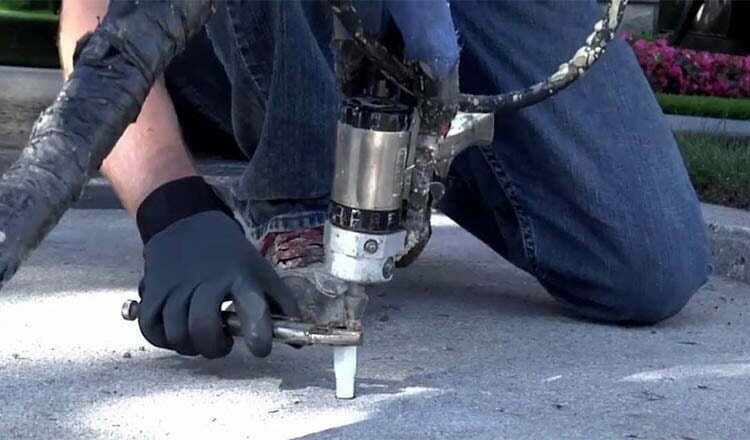
Polyurethane concrete raising drills a nearly invisible 5/8 hole and the process calls for considerably fewer holes than traditional mudjacking.

Cost

All concrete raising is typically half the cost of replacement. polyurethane is the choice above the rest because of the small hole size, lighter material weight, and fewer injection holes, and the quicker curing time.

Back to top

Wall Injection System

What is airKrete?

airKrete® is a thermally efficient and environmentally responsible, non-toxic insulation, which is easily foamed into closed cavities in walls, roofs and ceilings. At the time of application, its consistency is like shaving cream and after a few days, it hardens into a stable foam to maintain long-lasting, high insulation value. Its basic raw material components are air, water, and cement, which when combined, create a cost-effective, safe and high performance product. Developed over 20 years ago in the United States, airKrete’s efficiency is both time and test proven and is now available in Canada.

Installation

Most homes can be retrofit-insulated with airKrete in one to two days. Since it doesn’t produce dust or off-gassing, homeowners don’t have to move out of the premises during installation. The retrofit process is as follows:

  1.  1.5” inch holes are drilled into the interior walls between each set of studs. (Depending on the building’s layout and construction, holes may also be drilled from the outside).
  2. airKrete insulation is mixed in drums outside the home.
  3. The insulation – which has the consistency of shaving cream – is then pumped through hoses into the house and “foamed” into each drilled hole using low-pressure (2 lbs.) air.

When completed, interior holes are patched with drywall compound and exterior walls are fixed to appear the same as before the retrofit.

Product Summary & Characteristics

Environmental Characteristics
Fireproof Characteristics
Thermal Resistance
Formaldehyde none
VOCs, CFCs, HCFCs none
Asbestos none
Corrosiveness none
Mould growth none
Flamespread factor 0
Fuel contributed factor 0
Smoke density factor 0
K factor .257 per 1" thickness
R value 3.9 at 2.07 lbs/ft3
Percentage shrinkage 0
Odour none

Certifications and More Information About airKrete

Developed in 1987, airKrete®’s revolutionary insulation technology surpasses more traditional products for performance, safety, comfort and durability. A cement-based (i.e. cemetitious) product, airKrete® consists of magnesium oxide (made from sea water and ceramic talc).

airKrete® is certified to the most stringent standards for insulation ratings, safety and fireproofing, and is also LEED-compliant. Most importantly, because airKrete® is non-hazardous, no special installation equipment is required and leftover waste can be disposed of safely.

Since it was first introduced to market, airKrete® has been successfully installed in thousands of retrofit and new building projects in the U.S. and Canada. Installations range from residential buildings and single family homes to commercial and industrial properties including hospitals and museums.

Today airKrete® is recognized and endorsed by many high profile industry leaders and associations (including Al Gore and the Audobon Society) as an environmentally sound product.

Commonly Asked Questions

Q. Why have I never heard of airKrete® insulation before?

A. Developed and patented in 1984, air krete® is both time- and test-proven. Until recently, airKrete® has been available only in the United States and was expensive. Because of high energy costs and government incentive programs for increasing energy efficiency in homes airKrete is now a very affordable application.

Q. Does it shrink or settle?

A. airKrete® does not shrink or settle due to the exclusive formulation and the inherent qualities of the product. There is no equivalent insulation available.

Q. How will insulating my home with airKrete® reduce my energy consumption?

A. Uninsulated walls are a major source of energy loss as they are empty and prone to air leaks around electrical and plumbing areas. airKrete® fills wall cavities 100% to form a solid, air-tight barrier. As a result, your energy needs for heating and air-conditioning will be reduced. Click here to learn how R-value works.

Q. What kind of cost savings can I expect?

A. Your energy needs will be reduced dramatically between 30% and 50% depending on the construction of your home. airKrete® will pay for itself within a couple years.

Q. Will insulating with airKrete® make my home more comfortable?

A. Yes. airKrete® fills the empty wall cavities completely to eliminate convective air movement and provide a more uniform temperature throughout your home.Click here to learn how R-value works.

Q. I’ve heard about expansion foam insulations. How is airKrete® different?

A. airKrete® is foamed, or pumped, into wall cavities. It is NOT an expansion foam which could cause damage to walls during installation. airKrete® is a lightweight “foamed cement” which does not shrink or settle and is very safe to use.

Q. How safe is airkrete®?

A. airKrete® does not contain hazardous materials of any kind it is made from magnesium oxide (a mineral derived from seawater), ceramic talc, a foaming agent and water. airKrete® is 100% non-toxic it is inorganic, formaldehyde-free, odourless, mould resistant, and non-corrosive. Ideal for those with chemical sensitivities. airKrete® also exhibits a de-oiling effect which deters insects and rodents.

Q. Is airKrete® fire-safe?

A. airKrete® is 100% fire-safe – it will not burn or produce toxic fumes.

Q. How long does it take to install airKrete®?

A. Depending on the size, design, and construction of your home, installing airKrete® could take one day for smaller projects to several days for larger projects.

Q. Is this an economic thing for us to consider doing?

A Government rebates will subsidize a large portion of the installation costs. Insulation in your walls is like money in the bank. In a way you are paying for the airKrete® insulation right now… with higher fuel bills. Investing in airKrete® makes good sense both from the point of view of money saved on energy bills and the standpoint of increased comfort.

Back to top


Fibre and Attic Insulation

Why Should I Upgrade My Attic Insulation?

The department of energy estimates that heating and cooling loads consume between 50 and 70 percent of the energy used in an average home. A significant portion of that energy consumption results from the homes interior environment escaping through the ceiling where insulation is inadequate and poor vapour barriers fail to provide a proper air seal. Improving the ventilation in your attic and installing Ener-Spray's super seal insulation system could save you hundreds of dollars a year in energy savings.

What Do I Need to Know About Upgrading my Attic Insulation?

Before you upgrade your attic insulation you need to have its current condition assessed. The best way to determine what your attic needs to become more efficient is to call a professional insulation company to do an evaluation. Ener-Spray has qualified, experienced tradesmen who can come to your home and evaluate your attic's insulation for free. We will determine the condition of your attic insulation and make recommendations concerning what should be done to improve the efficiency of your attic. Click Here to book a free evaluation.

What Are my Options for Attic Insulation?

Insulation varies in terms of R value and performance. The R value measures the resistance of the material to the transference of heat, however, there are many factors that can reduce the R value of a material such as wind, cold and air pressure. Materials that cannot stop air have their R values reduced up to 60% when temperatures drop below freezing and winds start to blow. Ener-Spray’s super seal attic insulation system is the only way too stop air leakage and maintain a consistent R-value when temperatures drop below freezing and wind starts to blow.

What Should I Look for When Upgrading my Attic Insulation?

Blown–in insulation is the most common choice because it can fill areas that are hard to reach using other insulation types. Blown –in insulation will settle, therefore it is important that the original depth of insulation allows for the settling. Before you have new insulation installed make sure to have your contractor look at your vapour barrier. Does it comply with current building codes and is it providing a good air barrier to stop air leakage? Does the contractor you're using offer a product that can repair your vapour barrier should it need repair? Proper ventilation is very important to your attic, it keeps your attic dry and allows heat to escape in the summer. Ensure that when you add more insulation to your attic that your ventilation is maintained and that it is improved if needed.

Back to top